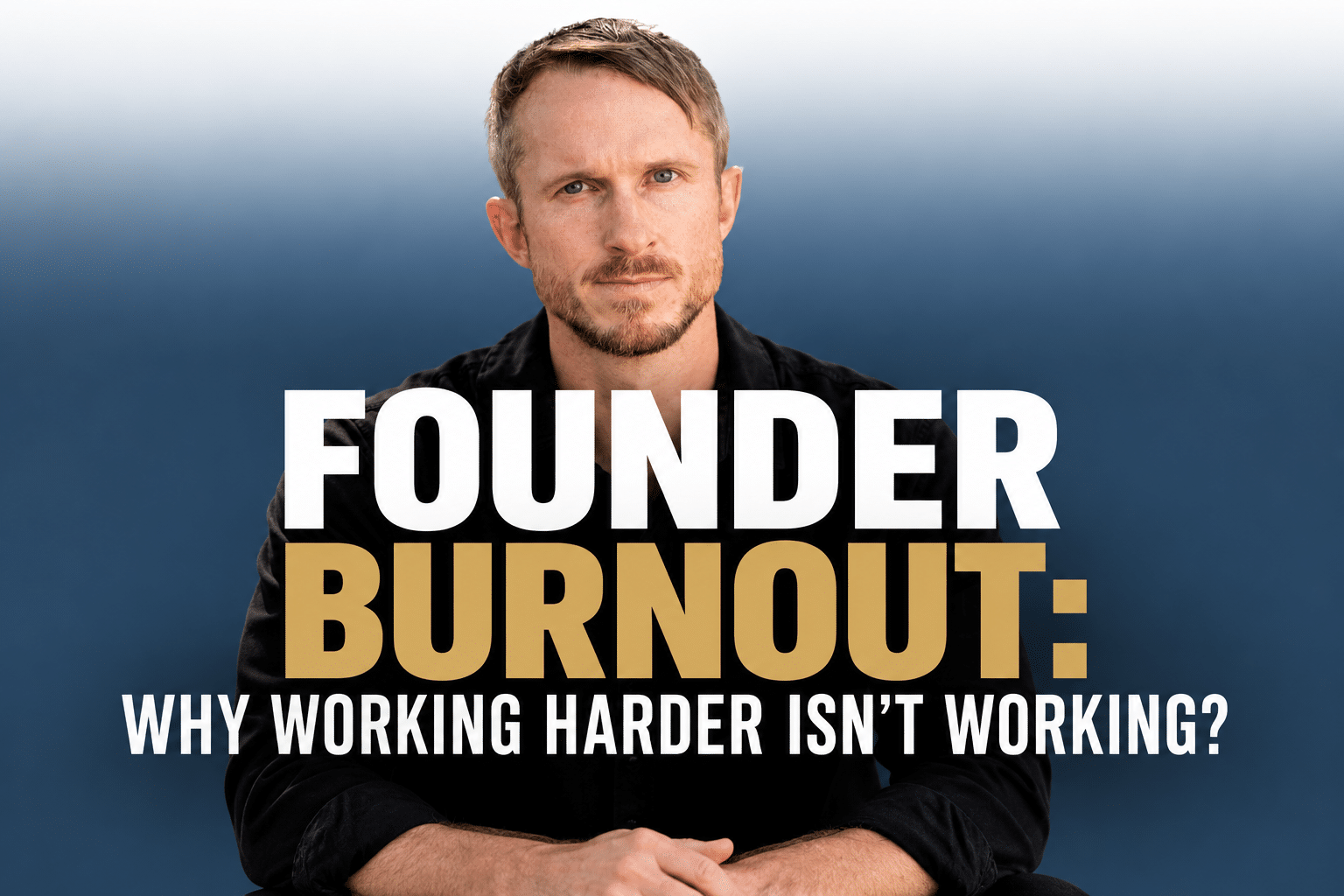
This article comes from an episode of The Unstuck High Performer Podcast. Listen to the full conversation below.
Founder burnout rarely starts with a breakdown. It starts with a routine. You are the first one up and the last one to shut it down. You answer messages at dinner, carry decisions home, and lie awake replaying what you missed. And you still feel like you are falling behind, so you promise yourself you will push even harder.
Why your work ethic stops being your advantage
Working hard built your business. I am not going to tell you it doesn’t matter. Your willingness to stay with the problem and do what most people won’t is a big part of why you have the success you have today.
But look at who you are competing with now. The people at your level are ambitious and they care deeply about what they are building. They will take the early flight, have the difficult conversation, and stay up late when something is on the line. Most of them can work just as hard as you.
So where does your separation come from? For a lot of high achievers, the first answer is “I’ll just push harder.” Maybe you can, for a while. Then the extra hour and the extra weekend stop making you sharper. You start making decisions from a depleted state, taking on work a team member could do, and reacting as if every issue is an emergency.
The real separation factor at this level is your willingness to look inward and unlearn the patterns that no longer serve you. That is a different kind of work than the one that got you here.
You may be pressing the accelerator while riding the brake
From the outside, relentless effort looks like dedication. From the inside, some of it may be something else. Ask yourself whether all that effort is moving you forward, or whether part of it helps you avoid the discomfort of letting go, trusting someone else, or sitting still long enough to feel the pressure you are under. That avoidance is often what keeps founder burnout going.
That is a hard question, because “work harder” has been your answer for so much of your life. But if you keep pressing the accelerator while also riding the brake, more horsepower won’t fix anything. The brake is usually a belief, a fear, or a habit you have never had a reason to question.
Working harder built your success. But what if the same strategy you keep reaching for is helping you avoid the very thing you need to face?
The beliefs that built your success are now costing you
A belief is simply a lens. It filters the decisions you make and the actions you take. And a belief can help you build something extraordinary and still cost you dearly later.
Take “If I’m not working, I’m falling behind.” Early in my coaching career, leads came to me through a company, and I had a green light, red light system that let me choose whether I wanted them. In five and a half years, I never once turned that light off. The more hours I worked, the more money I made, so I learned that more is better. There was never enough, and when I wasn’t working, I felt like I should be.
I hear versions of this from clients every week. One in financial advisory grew up poor and worked multiple jobs as a kid to help provide for his family. He spent three decades working to make sure his own children never tasted that scarcity. He had plenty of money to retire yesterday and take care of his kids and grandkids, yet it still didn’t feel safe to slow down. The belief had once protected him. Now it was ruining his ability to enjoy what he built.
Here are two more that tend to hide in plain sight:
- “Nobody will ever care as much as I do.” This may have been true when you were responsible for everything. If every decision still passes through you, your team can only grow as far as you can personally oversee it.
- “I have to earn my place every day.” It makes you driven, and it makes every win feel temporary. You wake up feeling like you are starting from zero, always chasing the next fix of progress.
Beliefs rarely announce themselves as beliefs. They sound like facts: “I can’t take my foot off the gas,” or “If I delegate this, it won’t get done right,” or “Once we hit the next number, I’ll finally have room to breathe.” Don’t judge the younger version of you who learned these things. Just notice what it costs to carry them unexamined into this chapter of your life.
When success outgrows your capacity to hold it
Sometimes the problem is not that you are failing to reach the next level. It is that the next level asks you to carry more than you are currently equipped to carry. More people rely on you, your decisions affect more livelihoods, and there is more visibility and less privacy.
You may recognize the signs. An opportunity lands in your inbox and you delay your response. You hired capable people, yet you are back to double-checking and triple-checking their work. Revenue is higher than ever, but you check the dashboard more than you did when you were struggling. You hit the goal, breathe for a day, and then immediately start worrying about maintaining it or climbing to the next one.
Your body often registers this before your mind does. It might be tightness in your chest before a big decision, butterflies when you hand something off, or an inability to feel settled when things are going well. That does not mean the opportunity is wrong for you. It is simply something to pay attention to.
Think of it like adding another floor to a house. Every new floor increases the load, so you have to look at what supports it. Can you recover physically, mentally, and emotionally after an intense stretch? Can you trust your team and trust yourself to delegate? Can you talk honestly with your spouse? Can you make a hard decision without treating the outcome as a verdict on your worth? That is what I mean by building the capacity to hold more success. This is a big part of the work I do in coaching founders and CEOs.
Why “just delegate” never lasts
Your subconscious has one priority: keeping you safe. Your current level of success is predictable, comfortable, and familiar, so it feels safe. A bigger level means more attention, more pressure, and more weight, and your subconscious may find creative ways to protect you from that.
That is how you end up with a gap between what you say matters and what your habits create. You say you want freedom, but every decision needs your approval. You say your family is why you work this hard, but when you are home your mind is still at work. You say you want a team you can trust, but the moment someone does something differently, you take the responsibility back.
If being needed makes you feel valuable, stepping back will feel unsettling, even when freedom is what you want. And if achievement has always quieted the fear that you are not enough, reaching a goal only buys a moment of relief before you need another one.
Those are surface-level solutions attempting to solve a deep-rooted issue.
That is why “just delegate” and “just be more present” rarely stick. If the belief underneath stays the same, the old pattern will pull you back.
The next time you catch yourself overworking, taking back control, or pulling away from the people who matter most, ask three questions. What happened right before I did that? What was I afraid might happen if I chose differently? What did that behavior give me in that moment? Maybe it gave you control, or kept you from disappointing someone, or protected you from admitting you felt overwhelmed. Once you see what the behavior does for you, you can find a better way to meet that need. This kind of mindset work is where real change starts.
What to take with you
Pick one recurring moment when you feel compelled to push, control, withdraw, or prove yourself. Name the trigger, then name the feared consequence: “If I don’t do this, then ___ will happen.” Question whether that consequence is certain or just an old expectation. Then choose one small different action. Let a teammate own a decision. When your VP of marketing sends a slide deck you think you could improve, reply “all good.” Take an evening off without checking in. Tell your spouse exactly what you feel or need.
Then notice what happens, including how uncomfortable the new choice feels. That discomfort doesn’t prove the choice is wrong. If you have ever changed your golf swing, you know that new patterns feel awful before they feel natural.
- At higher levels, effort alone stops separating you from competitors who work just as hard.
- Extra hours can disguise exhaustion, avoidance, and an inability to give up control.
- Beliefs like “If I’m not working, I’m falling behind” and “I have to earn my place every day” built your success and can now limit it.
- A new level of success can exceed your emotional capacity to hold it, so look at what supports you before adding another floor.
- Your subconscious may prefer familiar success over a bigger, uncertain future.
- Surface-level fixes fail when the belief underneath stays unchanged.
- Change starts when you catch the trigger, name the fear, and make one small different choice.
You can keep doing what you have always done. You can get up earlier, stay later, and find another gear, and knowing you, you will make it work. But ask yourself who gets what is left over when you do. If every new level costs you more of your health, your peace, and your presence with the people you say matter most, the answer cannot keep being “work harder.” You have already proven you can do that, and the work now is understanding why you feel you have to carry so much alone.
Ready to Do the Work Underneath the Work?
If this hit closer than you expected, that is the signal. A discovery call is 30 minutes: an honest conversation about what is actually going on and whether working together is a fit.